

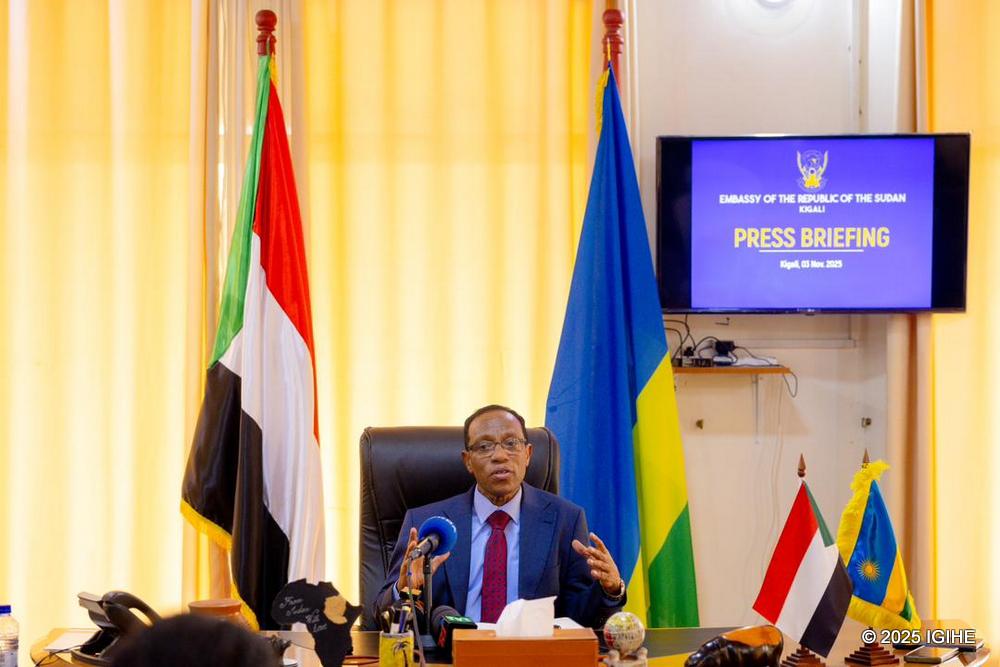
The Sudanese Ambassador to Rwanda, Khalid Musa Dafalla, has highlighted the deteriorating situation in Sudan due to the three-year war between the government forces and the Rapid Support Forces RSF, and how they see President Paul Kagame as a mediator who can provide a solution.
He reiterated this on November 3, 2025, when he spoke to the Rwandan media about the three-year-old conflict.
Since the war began in 2023, more than 150,000 people have lost their lives, 13 million have been displaced, and the country is suffering from drought.
The city of El Fasher is currently the scene of heavy fighting, since the group seized control of more than 60,000 residents and displaced them.
Ambassador Khalid Musa pointed out that the fighters of this group continue to commit “Genocide” because they kill people based on ethnic groups and that they are supported by various countries, including those that provide them with money and weapons, including drones that can be used for long-range attacks.
Sudan claims to have evidence that countries including major powers have a hand in the three-year-old war.
The Wall Street Journal recently published a story that revealed that the weapons used by the group’s fighters include those made in France, Britain, the United States, and others.
Amb Khalid Musa said that the group is using modern equipment including long-range missiles and combat vehicles, weapons that are not easily encountered by the armies of countries in Africa and about 10,000 mercenaries from 17 countries including those from Colombia, Ukraine, Ethiopia, South Sudan and others.
He said “This shows how this genocide is being carried out, it is not only RSF but there are mercenaries and powerful countries that are helping them.”
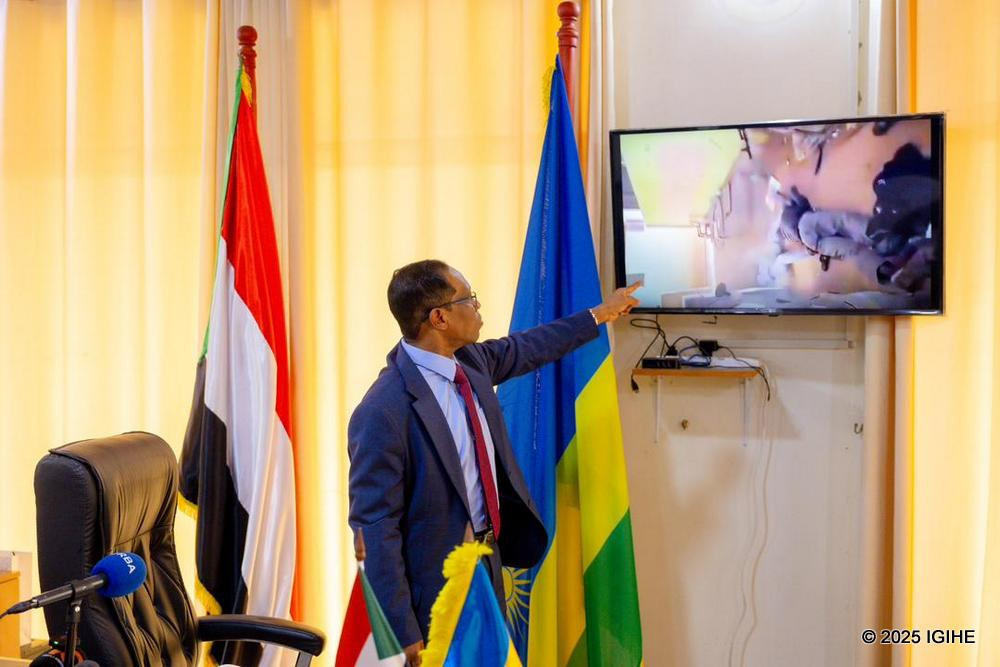
On the night of October 26, 2025, Ambassador Khalid showed himself as a human being in the city of El Fasher where this group killed 3000 people including patients in various hospitals, children were tortured, people were buried alive, they were run over by cars and so on.
These are actions that also affect relief efforts because this group has chosen to use starvation on the population as a weapon in this war.
He stressed that the group’s fighters continue to commit crimes, appreciating that countries continue to condemn them but saying that it is not enough.
He said, “In fact, they should not hold RSF responsible for what it is doing, they condemn it and express their concerns, but we Sudanese people also need justice and transparency. We are waiting for the UN Security Council to hold RSF accountable for the crimes they are committing. We Sudanese people are very angry.”
Sudan says the war has had a major impact, with more than 13 million people displaced.
“Imagine all the Rwandan people who have fled. This is happening in Sudan because of RSF,” he said.
In addition to killing civilians, the RSF is accused of severely damaging infrastructure, including hospitals, schools, hydroelectric dams, water supply, and Khartoum airport, using 18 drones.
Learning from Rwanda
Amb. Musa Dafalla said that the unity and reconciliation that Rwanda has demonstrated is a great lesson for African countries and that they should also learn from it.
He welcomed the way it has a program to rehabilitate former members of armed groups fighting against the government operating in the Congolese forests, confirming that they can also use this method when the fighting is over.
He said “This is one of the things we believe we will put our efforts into, so that the Sudanese people can live together in peace and development.”
The Sudanese government said that only one army is needed, the International Community should declare RSF a terrorist organization, stop the transfer of arms to this group through various channels and that RSF be held accountable for its crimes in Sudan.
He stressed that there should be no amnesty and that those responsible for their actions must be held accountable before the courts.
He confirmed that Rwanda can assist in efforts to end the war in Sudan through various means, including political ones as a country committed to peace.
He said, “We need Rwanda to do two things, namely to be a partner in achieving peace, and to help the Sudanese people reach a real solution through mutual cooperation, and we appreciate the role of President Paul Kagame and we also hope for political assistance to Rwanda.”
He continued by saying that Kagame could help in urging countries that are supporting RSF to stop it and that his experience could help.
He said, “Paul Kagame’s leadership in this matter is needed, because he is trustworthy, has the trust of the Sudanese, the experience and the wisdom to help in this Sudanese issue.”
Amb. Khalid Musa praised the continued expansion of Rwanda-Sudan relations, with the current number of Sudanese living in Rwanda numbering 6,000, and the increasing trade between the two sides.
In the past six months, Sudan has imported more than $4 million worth of coffee and tea from Rwanda and this will continue.
Currently, Sudanese investments in Rwanda continue to increase, including a glass factory operating in Rwanda, a Sudanese Medical University, and others.
The ambassador said that the Sudanese will repay the kindness shown to Rwanda upon their return to their country by maintaining good relations between the two sides.