

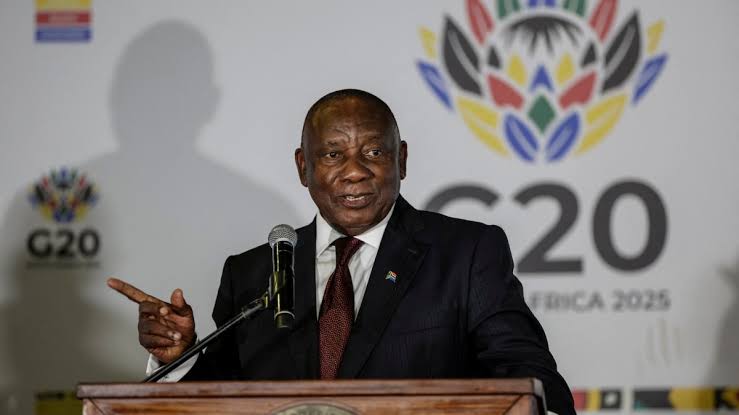
South Africa is putting finishing touches on preparations to welcome global leaders to the G20 summit in Johannesburg this weekend, a landmark first for Africa, though clouded by the absence of the United States. President Donald Trump’s decision to skip the meeting has stirred debate about the summit’s weight, even as South Africa steps forward as a champion for developing countries.
A total of forty-two nations are set to attend, but the U.S., a founding member of the G20 and next in line for the rotating presidency will be missing. While officials in Pretoria admit the absence is unsettling, they argue it also presents a moment to prove that global cooperation can continue without Washington’s involvement.
Dr. Frederich Kirsten, an economist at the University of Johannesburg, believes the boycott could unexpectedly sharpen the summit’s direction. “With the U.S. pulling out, there’s definitely an effect,” he explained. “But some analysts say it could actually be beneficial. Without competing agendas, the focus becomes clearer, and that boosts South Africa’s role.”
Throughout its G20 presidency, South Africa has emphasized finding financial solutions for developing economies, especially those grappling with climate-related pressures. Although Africa holds roughly 60% of the planet’s renewable energy potential, it receives just about 3% of worldwide clean-energy funding.
Pretoria is expected to advocate strongly for reforms that could unlock the estimated $1 trillion per year needed by 2030 to strengthen climate resilience and support energy transitions across vulnerable regions.
Back home, however, frustrations are surfacing. Johannesburg officials have begun a costly clean-up drive to refurbish damaged infrastructure ahead of the summit, but some locals view the effort as cosmetic.
Unfortunately“Us hosting this G20, I don’t really think it’s going to be beneficial for ordinary South Africans,” said resident Lerato Lelusa. “It’s just a way to waste money.”
Others are more hopeful. Teacher Phakama Vezi said the arrival of foreign leaders could help shift negative perceptions about the country. “I’m happy world leaders are coming,” she said. “I think those who’ll be here will have a story to tell when they go back.”
As international delegations begin landing, the moment carries weight: for Africa’s influence in global affairs, for South Africa’s diplomatic standing, and for whether the summit can still deliver significant progress without one of its strongest voices.