


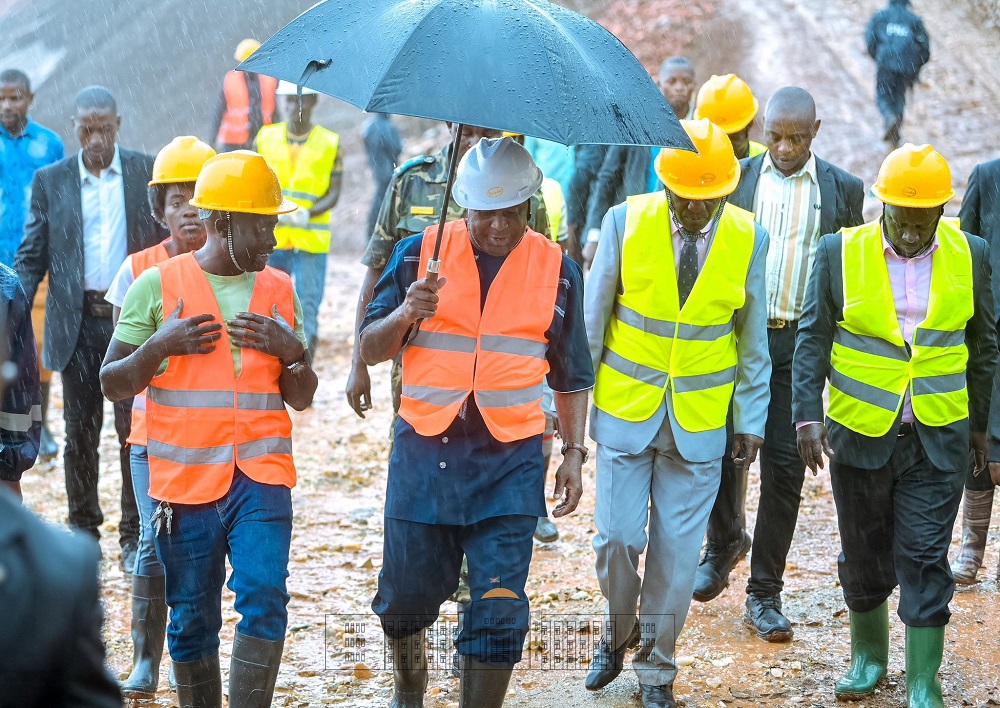
Burundian President Evariste Ndayishimiye recently jumped while visiting a gold mine in Bujumbura Province on November 14, 2025, when a section collapsed and injured his bodyguards.
The Head of State has recently appointed municipal leaders and visited mining operations across the country.
On November 14, he visited a gold mine in Mugina Commune after appointing its director. He was wearing boots, a jacket and a helmet, and covered himself with an umbrella because it was raining.
While President Ndayishimiye was visiting the mine on Mageyo Hill, a heavy object exploded, knocking President Ndayishimiye and everyone present to the ground.
Three soldiers assigned to President Ndayishimiye’s close security were seriously injured, but he was unharmed. They were immediately taken to hospital for medical attention.
Some thought it was lightning, but the French Ambassador to Burundi, Sébastien Minot, declared that what happened in Mageyo was a typical explosion that occurs in many mines, thanking God that President Ndayishimiye survived because many people die in it.
The diplomat said, “The explosion that occurred during Mr. Evariste Ndayishimiye’s visit is typical in the mining industry and is called a ‘coup de grisou’. It would have killed 15,000 people in France alone. Thank God, the President survived.”
A ‘coup de grisou’ occurs when gases, especially methane gas, accumulate in large quantities in mines. A major explosion occurs that can generate fire, burning or suffocating people nearby.
In 1906, more than 1,000 miners in Pas-de-Calais, France, were killed by these gases. The mining company had previously been warned about the high levels of gas that could be dangerous, but they ignored it.
In 1925, a gas explosion occurred in Dortmund, Germany, while mining coal. It killed 130 workers.
In Bois du Cazier, Belgium, a gas explosion killed 262 miners, most of whom were Italian immigrants. The accident led to the introduction of many regulations to protect miners.