

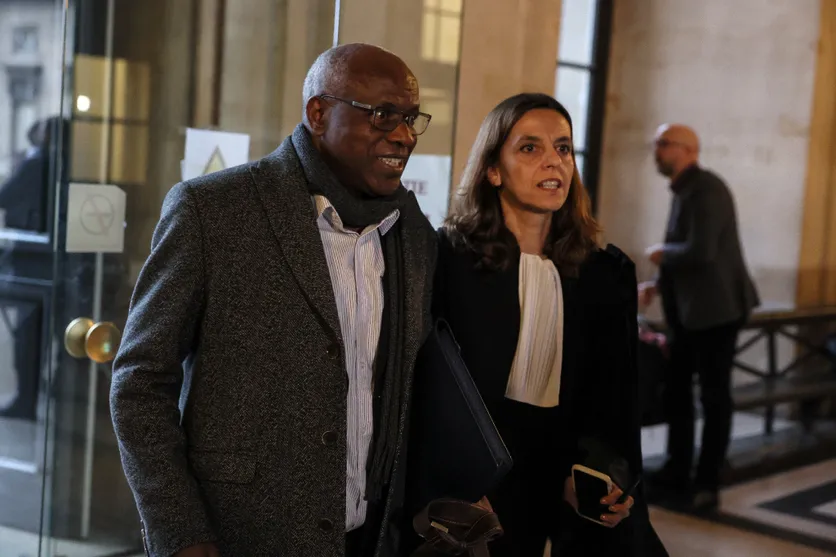
Dr. Sosthène Munyemana, who was recently convicted by the Paris Court of Cassation after being found guilty of the 1994 Genocide against the Tutsi, has appealed to the French Court of Cassation to order a new trial.
In December 2023, the Court of Cassation sentenced Dr. Munyemana to 24 years in prison after finding him guilty of genocide in Butare, particularly in the Tumba sector. This sentence was upheld by the Appeals Chamber on October 23, 2025.
The compensation trial for Dr. Munyemana is expected to begin on June 8, 2026.
Me Richard Gisagara, one of the lawyers representing the plaintiffs in these cases, announced on November 4 that Dr. Munyemana has appealed to the Court of Cassation, and that the parties were notified today.
He said, “Dr. Sosthène Munyemana appealed to the Court of Cassation. The notice was sent to the parties today.”
The Court of Cassation examines the appeal of a convicted person. What it looks at is the respect of the law in the case, it may conclude that it was not respected, and order a new trial.
Dr. Munyemana from Butare
Dr. Munyemana is a gynecologist. Before and during the genocide, he worked at the Butare Hospital, and was also a professor at the former National University of Rwanda (UNR).
He was a member of the MDR party, Vice President of its Intellectuals’ Circle (Cercle des Intellectuels) in Butare, and a friend of important leaders, including Kambanda Jean, who was Prime Minister in the government that called itself the Abatabazi.
The court found that the reputation Dr. Munyemana had built gave him the authority to carry out many actions that affected the people of Butare, especially since he spoke clearly.
On April 16, 1994, Dr. Munyemana and his colleagues who were members of this professional group signed a document supporting the transitional government that played a major role in the genocide of the Tutsi.
The court found that before Dr. Munyemana signed this document, he was well aware that the Genocide had already begun in the country nine days earlier because he followed the media, and therefore his intention was to support the continuation of the killings.
The court document signed on October 27, 2025 states: “It is clear that the accused willingly supported since April 16, 1994, the transitional government prepared and implemented a plan, calling on Hutus to ‘start work’, which meant continuing to kill the ‘enemies’ called Tutsis throughout the country.”
Dr. Munyemana on patrols, roadblocks and the Sector
The court confirmed that Dr. Munyemana attended a meeting held at the Tumba Sector office on April 17, 1994, where a decision was made to initiate patrols and set up roadblocks, and was included in the security committee responsible for implementing it.
It found that since April 21, 1994, patrols and roadblocks were used to search for and arrest Tutsis for their execution.
The court document explains that Dr. Munyemana knew full well that Tutsis would be arrested on patrols and at roadblocks, but he continued to participate, and that he did not stop the violence against Tutsis or protect those who were being abused.
The court found that Dr. Munyemana imprisoned many Tutsis in the Tumba Sector office, and that many of them were arrested and killed.
It ruled that he prevented them from escaping, and that he released them so that the Interahamwe could recruit others, and that he would start meetings where decisions were made to take them away instead of killing them.
Witnesses, including families of genocide survivors, testified that Dr. Munyemana was putting Tutsis to death. One of them said that one of the Tutsi detainees in the Sector office survived.
How his explanation was undermined
Dr. Munyemana said that he did not know that the killings were planned, but the court found that he knew for sure because he listened to Radio Rwanda all the time, knew what was happening in Kigali, saw Tutsis fleeing, and was close to the leaders who planned the killings.
The doctor said he had imprisoned Tutsis to save them, but the court found that imprisoning them in a small building without basic necessities such as water, food, or guards was intended to house them for the killers.
He said he did not know what happened to the Tutsis who had been taken from the Sector office, but it was clear that he had never inquired about their fate, yet he was clearly aware that the people he said he was “rescuing” had disappeared.
Dr. Munyemana admitted to the court that the then Tumba Councilor, François Bwanakeye, gave him the keys to the office of this Sector, which he held from April 23 to May 19, 1994.
In order to demonstrate that he had nothing to do with the killers, Dr. Munyemana explained that he was a doctor who had nothing to do with politics. The court found that this was not the case, because he had participated in politics in Butare and at the national level.
The judges who ruled on this case showed that Dr. Munyemana had a direct role in the Genocide, by detaining Tutsi in the Tumba Sector office, and he knew full well that they could kill, because this constituted the crime of depriving people of their freedom, and he was involved in the plan to kill Tutsi.
The court showed that Dr. Munyemana had a role in the plan to prepare the genocide, through his actions in various meetings, supporting the government that planned the genocide and joining the security forces that were intended to search for and arrest Tutsi.