

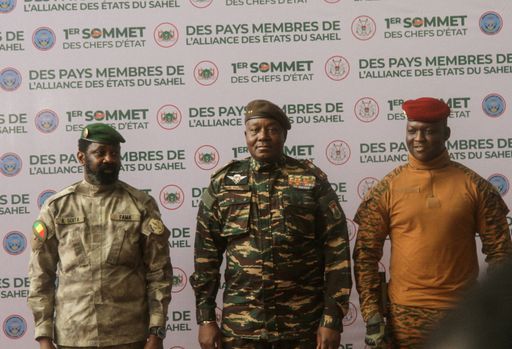
The Alliance of Sahel States has moved further toward regional self-rule as the military leaders of Mali, Niger and Burkina Faso gathered in Bamako for high-level discussions.
The second AES summit is focused on deepening cooperation within the bloc and cutting dependence on the West African regional body, ECOWAS. Key issues on the agenda include defence and security, development, communication strategies and joint counterterrorism efforts across the three countries.
Malian leader Assimi Goïta welcomed Niger’s President Abdourahamane Tchiani at Bamako’s airport on Monday before both leaders proceeded to the presidential palace. Burkina Faso’s President Ibrahim Traoré arrived on Tuesday morning after an unexpected delay.
Mali, Niger and Burkina Faso formed the alliance in 2023 and formally exited ECOWAS last year. The decision followed strained relations with Western partners after a series of military takeovers in the three countries.
Ahead of the summit, the alliance announced the creation of a joint military force aimed at tackling terrorism in the Sahel region.
On Tuesday, Goïta, Tchiani and Traoré also unveiled the Alliance of Sahel States’ television channel, which officials say is intended to counter disinformation and promote the bloc’s shared goals.
Goïta was named president of the alliance at last year’s summit, and a new AES leader is expected to be appointed in Bamako this week.
Despite the withdrawal, ECOWAS has said it is still open to allowing Mali, Niger and Burkina Faso to retain certain benefits, including trade privileges.
However, the three junta-led nations have continued to assert independence, including by introducing new travel documents for their citizens.
They remain members of the West African Economic and Monetary Union, which ensures ongoing trade and free movement of goods among its eight member states, including Senegal, Ivory Coast, Guinea-Bissau, Togo and Benin.