

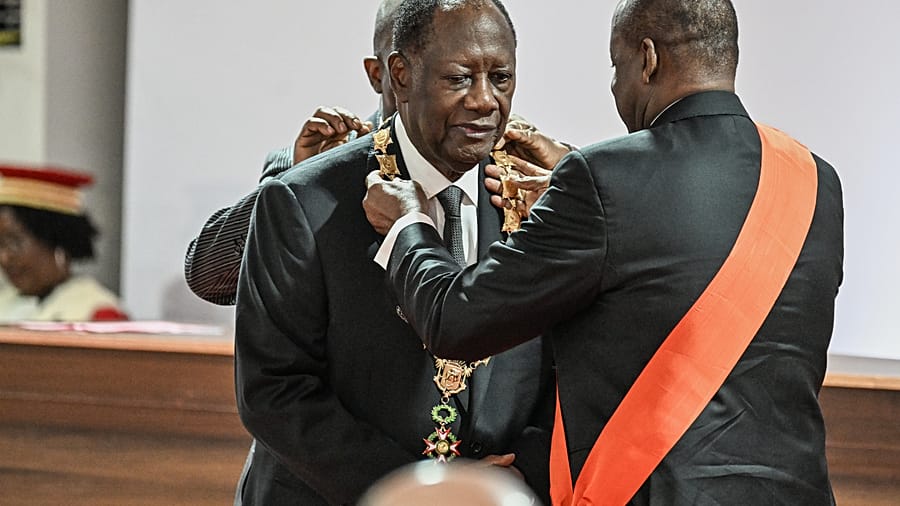
President Alassane Ouattara of Ivory Coast was officially sworn in Monday morning for his fourth five-year term, following an October election marred by low participation and a clampdown on opposition voices.
The swearing-in ceremony drew several regional leaders, including presidents from Mauritania, Liberia, Gambia, Ghana, Senegal and Gabon.
After taking the oath, Ouattara repeatedly highlighted the progress he believes Ivory Coast has made since he first took office in late 2010.”
On Saturday, October 25, Ivorians expressed their sovereign choice. They reaffirmed their commitment to democracy, stability, and peace; values we have worked hard to rebuild since 2011,” he said.
He also touched on regional security concerns, adding, “Our sub-regional environment remains fragile. Terrorist threats persist, evolve, and are increasingly digital.”
The 83-year-old leader first rose to power after a disputed 2010 election against his predecessor Laurent Gbagbo. Violence following that vote left more than 3,000 dead before Ouattara, backed by U.N. and French forces, ultimately assumed power.
Supporters credit him with reviving the conflict-damaged economy of the world’s top cocoa-producing nation. Critics, however, accuse him of consolidating authority and weakening democratic space.
Ahead of October’s poll, major opposition figures were blocked from contesting, including Tidjane Thiam and former president Laurent Gbagbo.
Protests erupted after Ouattara announced his bid for a fourth term. As the election neared, demonstrations were banned, yet many still took to the streets. Security forces fired tear gas and detained hundreds.
Still, many Ivorians back Ouattara, believing he restored growth and stability after years of war and post-election turmoil. Under his leadership, the economy has expanded at about 6% annually, boosted by cocoa exports.
Although Ivory Coast formerly had a two-term limit, Ouattara oversaw a 2016 constitutional reform that he later argued restarted his presidential term count.
He has also clashed with the junta-controlled governments of Niger, Mali and Burkina Faso, which accuse him of favoring France, blamed by Sahel regimes for worsening security challenges.