

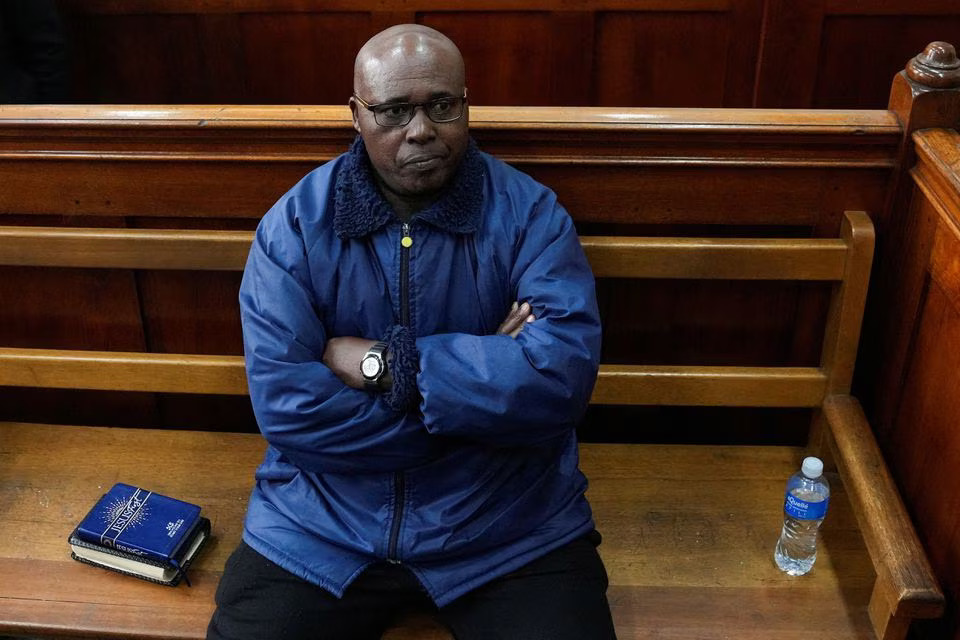
South Africa’s intelligence agency has revealed that reports that the Rwandan government wanted to kill Fulgence Kayishema, suspected of involvement in the 1994 Genocide against the Tutsi, are false.
Kayishema served as the Chief of Police in Kivumu Commune in Kibuye Prefecture during the genocide. He is accused of involvement in the deaths of over 2,000 Tutsis who were killed in the Nyange Church.
On May 24, 2023, he was arrested in Paarl, Western Cape Province, through a joint operation between agencies including the Office of the Prosecutor of the United Nations and the South African government, and was detained.
On September 10, 2024, he informed the South African government that he had reliable information that the Rwandan government intended to kill him in the prison where he was being held, requesting that he be transferred to another prison and that his name and identification number be changed.
He based this on the fact that in late August 2024, someone allegedly provided information that there were people who wanted to kill him. This prompted the South African government to take measures to increase his security in his detention center.
Kayishema’s statements prompted the Deputy Director of Public Prosecutions in the Western Cape, Tommy Aron Bunguzana, to request the Provincial Director of Public Prosecutions, Brig Gen Timothy Moyana, to conduct an investigation to determine the truth.
The Rwandan Genocide Investigation Unit conducted a preliminary analysis, which indicated that it was highly likely that the Rwandan government did not intend to kill Kayishema.
On 28 November 2025, Bunguzana informed the UN Interim Residual Mechanism for International Criminal Tribunals (IRMCT) that the in-depth analysis conducted confirmed that the Rwandan government did not match Kayishema’s statements.
The Prosecutor indicated that the informant who provided information about the plot to kill Kayishema was not credible and had personal reasons for seeking to pervert the course of justice.
Based on this reason, the Prosecutor explained that it was decided that Kayishema should continue to be detained in the prison where he is currently held, without changing his name or prisoner number.
Kayishema made every effort to avoid being extradited to Rwanda for trial, stating that he did not trust his safety while in Kigali. It got to the point where he asked South Africa to grant him asylum.
The IRMCT prosecution has long been requesting that Kayishema be referred to this body so that it can send him to Rwanda to stand trial.