

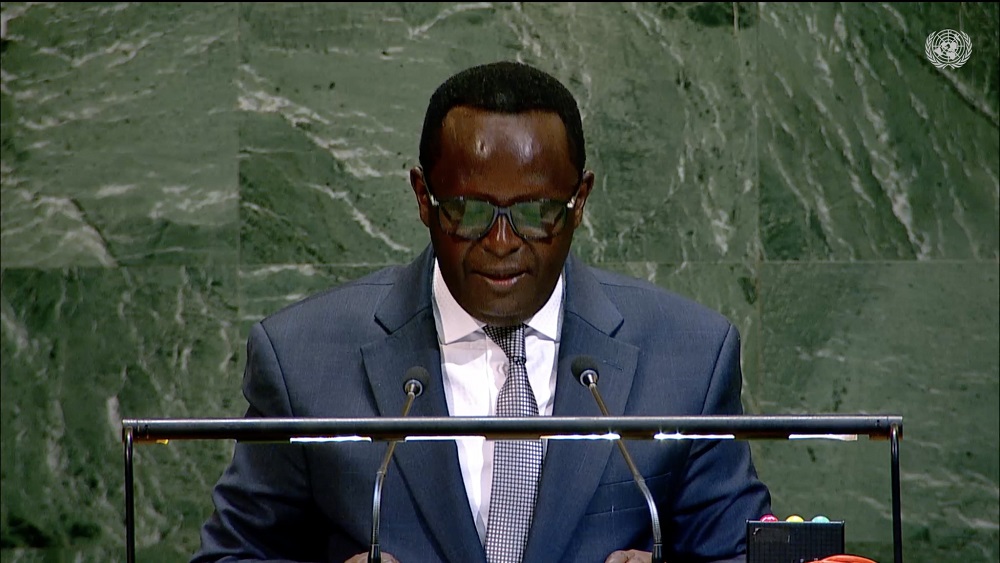
Rwanda’s Ambassador to the United Nations, Martin Ngoga, has called for developing countries not to be left out of the opportunities that sport offers for development and peacebuilding.
Ambassador Ngoga made the remarks during the United Nations General Assembly debate on the role of sport in development and peacekeeping, held on November 19, 2025.
“Sport is not a hobby, it is a bridge for diplomacy and a major investment in peace and human development,” he said. “For Rwanda, these are not words, they are experiences. A country that has emerged from the Genocide [against the Tutsi] is keenly aware of the power of sport to rebuild the broken, restore hope, reconcile citizens and inspire young people to believe in themselves again.”
He explained that Rwanda has built unity among Rwandans through sports, developed women and youth through sports, and that sports have been a pillar of the country’s development because it has been used to build infrastructure and promote tourism activities through international partnerships.
He said, “In an increasingly fragmented world, where conflicts are increasing and trust between countries is eroding, sport is one of the few international languages that can reduce tensions and create understanding. Rwanda believes that the international community should embrace sport as a means of diplomacy that can prevent conflicts and build peace and unity among people.”
Ambassador Ngoga pointed out that many developing countries are being deprived of sporting opportunities, often finding that these opportunities have been given to wealthy countries, claiming that they have the most modern infrastructure and the capacity to host international sporting events.
He said, “We call for equality and non-exclusion in the international sports arena. Many developing countries continue to be systematically excluded in terms of opportunities and visibility. Rwanda calls for investment in infrastructure to be supported, technology to be provided, and capacity building to be implemented to address inequalities.”
He called for the implementation of international sports development programs, including the United Nations’ strategic plan, so that sports benefit all countries in a more equitable manner, rather than in the same way.
The 2018 United Nations Agenda for Sport for Development and Peace outlines how countries can use sport to advance the 2030 Sustainable Development Goals.
The Agenda has five main objectives: to strengthen national efforts to promote sport for development and peace, to support sports policies and build national capacities, to promote inclusiveness in sport, to support research in sport, and to mobilize support for the development of the sector.