

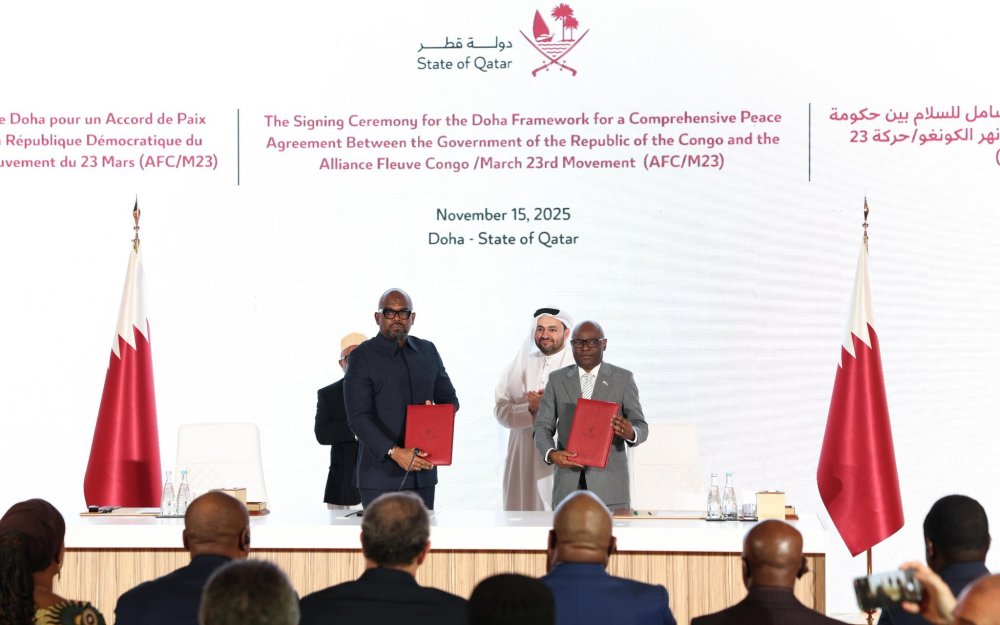
Representatives of the Democratic Republic of Congo and the AFC/M23 coalition signed on November 15, 2025, a set of basic principles that are expected to help the east of the country achieve lasting peace. It is a step taken with the significant participation of the State of Qatar, the United States and the African Union.
The document signed by Sumbu Sita Mambu of the DRC Government and Benjamin Mbonimpa of the AFC/M23 contains eight basic principles. Among them are the terms for the release of prisoners and the establishment of a body to monitor the implementation of the ceasefire, which has not been fully explained due to its failure in recent months.
In approving these basic principles, reference was made to the general principles signed in Doha, Qatar, on July 19, 2025, the Constitution of the DRC and international law, including humanitarian law.
These are the six new basic principles agreed upon by the DRC Government and the AFC/M23 after the seventh round of talks held in Qatar since last week:
Facilitating relief operations
The DRC government and AFC/M23 have established a basic principle of facilitating relief operations to reach populations in danger, to protect them and to provide them with assistance when necessary.
Among the expected measures to facilitate relief operations is the opening of the international airports of Goma in North Kivu and Kavumu in South Kivu, as well as the main roads in these areas.
Both parties agreed to respect international humanitarian law, including humanitarian law, human rights law, such as the protection of civilians and others affected by hostilities, the protection of “disappeared” and prisoners of war, respect for the dead and the protection of their families.
Based on this principle, the DRC Government agreed to declare a state of emergency in the eastern regions affected by disasters but also by prolonged hostilities, taking care of the population, both in terms of ensuring their security and helping them rebuild their lives.
Restoration of State authority, reforms and lasting governance
The two sides established the principle that State institutions and services must be restored throughout the country, in accordance with the Constitution of the DRC and other laws of the country.
It is expected that through the upcoming talks, the modalities, phases and timetable will be agreed, and that local and traditional leaders will be involved in matters of their competence.
The DRC government has agreed to carry out reforms in order to maintain political, security and national institutions, in the interests of the population, with the aim of achieving transparent, accountable and inclusive governance.
Both sides agreed to resume the activities of non-political institutions, resume the movement of people and goods, facilitate the population’s access to documents and open up essential services including banking, customs and infrastructure.
Without change, the DRC government could build on this principle and reopen banks in AFC/M23-controlled areas, particularly in the cities of Goma and Bukavu, which have been closed since early 2025.
It is expected that, as soon as it becomes possible, the DRC government and AFC/M23 will organize transparent elections through the National Assembly and local authorities.
Interim Security Arrangements
AFC/M23 and the Government of the DRC agreed not to support armed groups and to support the process of reintegration of former combatants, in accordance with the Constitution and international standards.
They agreed to establish an interim security structure to ensure security in the areas affected by the conflict in order to restore stability and protect the population. It was intended to last for five months but could be extended by mutual agreement of the parties, with the assistance of mediators.
The text of these principles also states that the extension of the duration of this structure will depend on the progress made in restoring government institutions and services in the areas affected by the conflict, and that its composition, governance and detailed responsibilities will continue to be discussed.
Both sides agreed that only qualified fighters from the Abanye-Congolese armed groups will be reintegrated into civilian life, and that there will be joint operations to dismantle foreign groups operating in the DRC.
Verification of the nationality of refugees and their repatriation
The main reason why AFC/M23 fighters took up arms is the long-standing persecution of Kinyarwanda-speaking Congolese, especially the Tutsi ethnic group, many of whom have chosen to flee abroad in order to save their lives.
The two sides agreed to facilitate the safe, voluntary and dignified repatriation of Congolese or foreign refugees, based on the procedures established by the DRC Government, the United Nations High Commissioner for Refugees (UNHCR) and host countries.
The DRC Government indicated that it would verify the nationality of refugees claiming to be Congolese before receiving them, and would provide them with security to prevent them from
being killed, from hate speech against them, from being labeled as xenophobic and from fleeing again due to insecurity.
It was planned that the verification of the identities and citizenship of refugees would be carried out in accordance with the DRC Constitution and the decision of the country’s Parliament.
Economic recovery
The fighting between the DRC army and AFC/M23 fighters has severely disrupted the economy of the population, as many have decided to stop farming, livestock, trade and other activities, and have fled to safer places.
The DRC government has agreed to take all necessary measures to restore basic services in areas affected by the conflict, in collaboration with international partners.
It is planned to establish a program to resume essential infrastructure work, improve the welfare of the population, education, health, environmental protection and support small and medium-sized enterprises of the population in order to recover their economy.
The economic recovery program will focus on supporting former armed groups who have been reintegrated into civilian life and others at risk of poverty.
Truth, Reconciliation and Justice Commission
The two sides agreed that the Government of the DRC will establish an independent commission responsible for promoting truth, reconciliation and prosecuting crimes committed during the war, which will identify areas for reparation in the context of justice.
The Government of the DRC and AFC/M23 agreed that the structure of this commission and its functioning will be based on the Constitution of the DRC and international law.
On these six new principles, both sides agreed that discussions on them should begin no later than two weeks after the document was signed on November 15.
As this document indicates, the subsequent discussions will include detailed measures for each principle and a timetable for their implementation.
The Permanent Secretary of the AFC/M23, Benjamin Mbonimpa, said that these principles are like chapters in a book, where you move on to another when the first one is completed. He explained that there is still a long way to go for peace.
Mbonimpa said, “Nothing will change on the ground or in practice until these principles are discussed and a final decision is made on the comprehensive peace agreement. Our people, please be patient, the journey is still long.”
US President Donald Trump’s advisor on Africa, Massad Boulos, also acknowledged that there is still a long way to go, but he assured that it will not be too long.