

A few days ago, the Regulatory Authority for Rwanda, RURA, announced new prices for petroleum products, with a liter of gasoline reaching 1,989 Frw, while that of diesel fuel is 1,900 Frw.
These are the prices that replaced the previous ones set in September 2025, where a liter of gasoline cost 1,862 Frw, while that of diesel fuel was 1,808 Frw. This means that a liter of gasoline has increased by 127 Frw, while that of diesel fuel has increased by 92 Frw.
It is rare in Rwanda for petroleum products to increase to this level.
In an interview with IGIHE, the Permanent Secretary in the Ministry of Trade and Industry, Antoine Marie Kajangwe, said that the increase in petroleum products this time is based on two factors.
He said, “To put it simply, I would say that the price increase was caused by two factors. You remember that in July the government introduced VAT on fuel prices, so if you add 18% to anything, prices go up. That’s why you saw them go up, but they also leveled off after that month.”
He continued, “In the past two months, what actually caused it to rise a little bit, otherwise today we import a lot of oil from Tanzania, the way the oil trade has been structured, you see that what comes from Tanzania is cheaper than what comes from Kenya, but due to some recent problems, those who import oil from abroad have started to import it from Kenya, and because it is a little more expensive, it has affected the prices in general.”
Rwanda usually changes the prices of petroleum products every two months. The reason is that it takes at least those months to get from the processing plants in Arab countries to Kigali.
This means that the price situation on the international market affects the prices in Rwanda after two months.
On November 15, 2025, the price of a barrel of oil on the international market was $60.09, down from $64.1 on September 1, 2025.
If you look at the past two months, this month is the month when the price has dropped the most, as since November 1 it has been trading between $60.98, $58 and $60.09.
The price of fuel in Rwanda is usually based on the international market price over the past two months, the cost of transporting it to and from the port of Dar es Salaam or Mombasa, the dollar exchange rate and the VAT tax that has been imposed.
The CEO of Rwanda’s petroleum products trading company, Société Pétrolière Ltd (SP), Habimana Claudien, said that sourcing from Kenya is one of the three reasons for the price increase.
He said, “We used to source a lot of fuel from Tanzania but now we have started sourcing it from Kenya and the prices in Kenya are higher. Another thing is that prices on the international market have increased slightly.”
Statistically, he showed that at least 99% of petroleum products imported into Rwanda came from Tanzania, but due to problems with slow unloading of ships and insecurity that emerged during the recent presidential elections, attention was focused on Kenya.
In September 2025, fuel imported from Kenya reached 34%, Tanzania reached 66%, in October 2025, that from Tanzania was 87% while that from Kenya was 13%. Overall, that from Kenya in those two months reached 23% from 1%.
He said, “So you understand that the fuel we import from Kenya has increased and is also expensive, causing the price to rise.”
Habimana pointed out that although the price of diesel has increased to 1900 Frw per liter, there is a government subsidy of 78 Frw per liter.
He said, “If they had not included it, it would have had a big impact. You know that diesel is the fuel that carries passengers, everything. The government included a subsidy of 78 Frw that was deducted from the tax. There was no subsidy on gasoline, which is why it is so expensive.”
He explained that despite this, both channels should be used to transport petroleum products because that would help the country.
What will be the impact on the national economy?
Kajangwe indicated that despite the increase in petroleum prices, efforts are being made to reduce them.
He said, “There are strategies that the government is working on to see how we can reduce these prices, including seeing how we can start improving the way the oil coming from Kenya is cheaper and we expect that in the next three to four months…”
Regarding whether a balance could be imposed, Kajangwe said that he was not sure but that the government continues to monitor it regularly.
He indicated that this should not have a major impact on the growth of natural products because the cost of transportation does not increase much.
In an analysis conducted by the Ministry, he indicated that there could be an increase of between 4 and 6 Frw in the cost of transportation per kilo for products from the East and between 6 Frw-8 Frw for products from the Rusizi District.
He said, “There should be no impact on other businesses, and you should also note that public transport prices have not increased. People should not use this as an excuse to increase prices. You see, those who want to benefit from it use it as an excuse to add 20 Frw, 30 Frw or 40 Frw to the price and it has no effect.”
Although he says this, based on an analysis conducted by MINICOM, if a truck carries five tons of goods, that is, 5,000 kilograms, the cost of normal transportation increases by between 20,000 Frw and 30,000 Frw, while if it leaves Rusizi District, it increases by between 30,000-40,000 Frw, making it difficult for manufacturers to accept the loss of these services, even though they have spent a lot of money on diesel.
One of the truck drivers from the Southern Province to Kigali City, Musabirema Cyprien, indicated that things have changed because the cost of travel has increased significantly.
He said, “Transportation has not increased, but the cost of buying diesel has increased. Before, I was paying 260,000 Rwf, but now it is 320 Rwf, so you can see that there is more money involved and he does not want to increase it. It is very difficult to understand, so instead of losing our jobs, we have to accept it and say that maybe when the time comes, they will understand.”
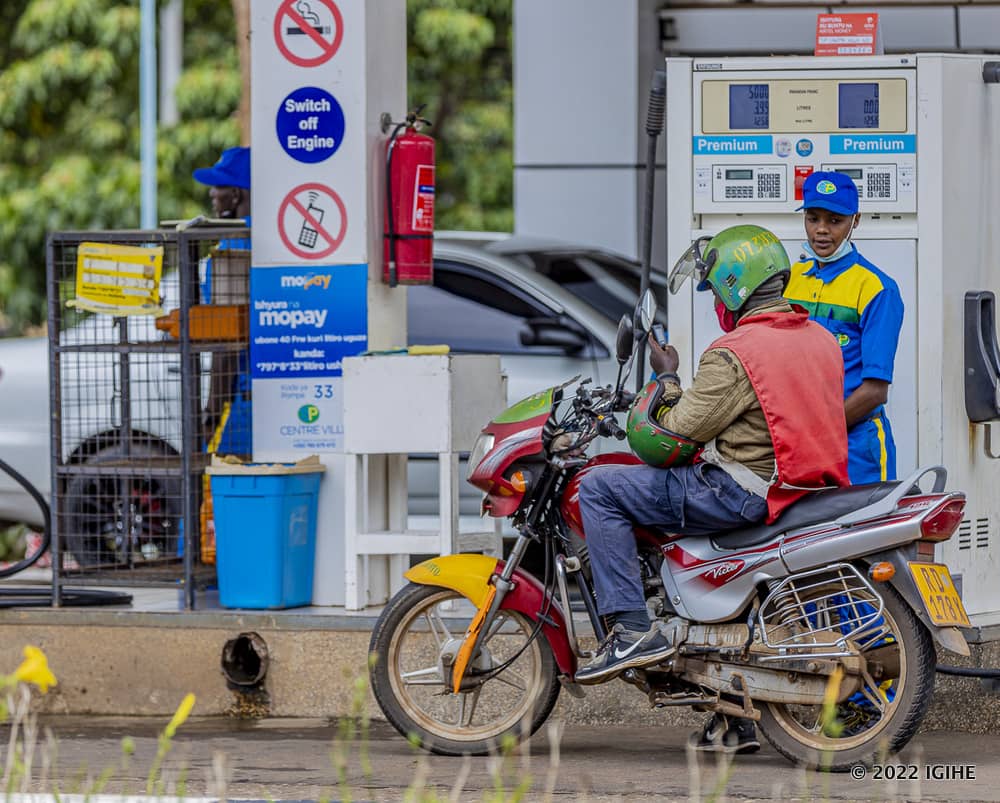
Nsengiyumva Modekse, a motorbike driver, said that seeing the price of a license increase of 123 Frw per liter puts them at a loss because customers do not want to spend more money.
He said, “You tell him that fuel has gone up, and he tells you that at work his salary has not changed.”
He said that a motorcyclist who uses 1,989 Frw per liter cannot earn more than 2,000 Frw, and there are other daily needs, including supporting his family.
Habimana Claudien said, “When fuel prices increase and the user’s budget does not increase, what he does is reduce his trips. If he reduces his activities, he is delayed. At that time, I start using the telephone instead of going to work.”
On the other hand, Economic Expert, Teddy Kaberuka, told IGIHE that price increases are inevitable when the prices of petroleum products increase.
He said, “What is known is that when the price of petrol and diesel increases, it affects the price in the markets, whether you like it or not. The person who normally transports goods to the market, transportation has increased, so it is not the person who used to take a truck to bring potatoes, diesel will increase and not be able to install it.”
He also pointed out that the increase in prices has an impact because it makes people unable to buy what they used to buy and the amount of what they buy decreases.
Currently in the East African region, for example, in Uganda a liter of petrol costs $1,420, which is 2,059 Frw, in Kenya it is 184.38 Kenyan shillings, which is 2,069 Frw, in Tanzania a liter costs 2,752 Kenyan shillings, which is 1,635 Frw, in Burundi the price of petrol is 4,000 Burundian shillings, which is 1,967 Frw, while in the DRC a liter costs $1,223, which is 1,773 Frw.