


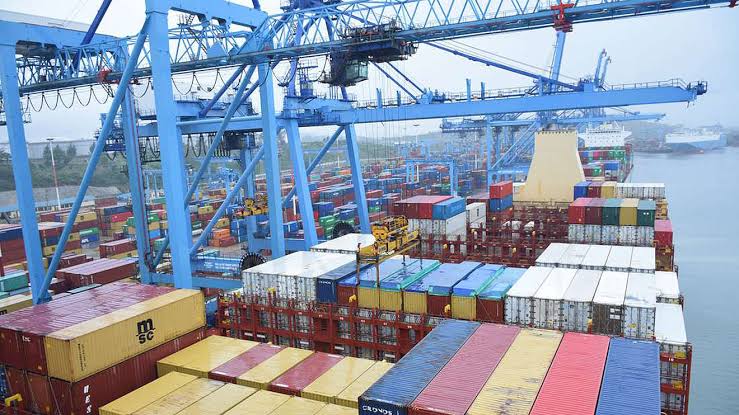
Persistent inefficiencies and political tensions continue to disrupt trade between Rwanda and Tanzania, prompting more Rwandan traders and transporters to turn to Mombasa port despite its longer distance and higher expenses.
The lingering impact of election-related riots in Dar es Salaam has left cargo trucks stranded for two weeks, causing shortages of several consumer goods in Rwanda and triggering price hikes.
For some traders, the post-election violence, during which trucks were burned and looted was the final straw, leading them to abandon the Central Corridor, while others had already switched to the Northern Corridor last year.
Derrick Baguma, a Kigali-based cargo operator, told The EastAfrican that an increasing number of traders have opted for Mombasa since last year due to “the inefficiencies and bureaucracy at Dar es Salaam port, which are absent in Mombasa.”
“In Mombasa, ships dock only when unloading space is ready, and machines are prepared. Cargo can be offloaded and delivered the same day. In Dar es Salaam, it can take up to two weeks. Kenyans have embraced port technology, boosting efficiency,” he added.
Although Mombasa’s fees are higher, $400 in shipping line charges compared with no charges at Dar es Salaam, traders consider the speed and reliability worth it. Additional costs like delivery orders and port handling fees apply at both ports.
The distance from Mombasa to Kigali is 1,700km, longer than the 1,300km from Dar es Salaam, yet Rwanda’s transporters are increasingly moving cargo away from the Central Corridor, historically the main route for 80 percent of Rwandan imports.
Perishables, construction materials, and petroleum products were hit hardest during the post-election blockades.
Reports indicate that three Rwanda-bound rigs were looted near the Namanga border, with goods worth about $200,000 lost. Two Rwandan trucks carrying fuel from Dar es Salaam were also burned near the port on October 30, according to Rwanda’s Ministry of Trade and the East African Business Council.
These disruptions contributed to a 57 percent drop in bond turnover and forced costly rerouting, with over 50 Rwandan trucks stranded and about 15 percent reporting damage or losses, the Rwanda Transporters Association reported.
Rwandan importers have since rerouted up to 60 percent of fuel imports through Mombasa, moving cargo worth over $300 million in Q4 2025. This strategy aims to reduce reliance on a single corridor amid regional tensions, though the trade challenges run deeper than mere rerouting.
Trade between Rwanda and Tanzania has declined sharply. Rwanda Institute of Statistics data shows imports from Tanzania fell to $52.91 million in September 2025, down from $92.64 million in September 2024, a drop of more than 40 percent year-on-year.
In the first quarter of 2025, imports fell 25.4 percent compared with the previous year. Between 2022 and 2023, Tanzania accounted for 13.6 percent of Rwanda’s total imports, valued at $567.86 million.
Rwanda’s exports to Tanzania remain largely stable, but protectionist policies have fueled tensions. Tanzania’s 2024 imposition of a Tsh2,000 ($0.73) per kilogram fee on milk, a 1,233 percent jump from Tsh150 ($0.055) has made Rwandan milk uncompetitive. Strict enforcement of the 2018 Animal Diseases and Animal Products Movement Control Regulations has further blocked Rwandan exporters from obtaining licenses.
Analysts warn that, while both countries show no overt hostility, rising trade and geopolitical strains point to underlying friction that needs resolution through bilateral channels. Regulatory delays mirror disputes between Kenya and Uganda, despite a January 2024 memorandum of understanding aimed at facilitating dairy trade.
Earlier this year, Rwanda and Tanzania clashed indirectly over the DR Congo conflict, with Tanzania contributing troops to a SADC mission, prompting Rwanda to accuse the country of colluding with the FDLR, a genocidal force.
Although relations were strained, cooperation between the two East African Community partners largely continued. Rwanda notably did not publicly congratulate President Samia Suluhu Hassan on her contested election win, fueling speculation of tensions. However, diplomatic channels confirmed a private congratulatory message was sent, a departure from traditional public announcements.